Where does leftover margin go after a liquidation on Binance, OKX or Gate?
What each exchange deducts at liquidation, on what base and who keeps it; how far the insurance fund goes when an account turns negative; and where Binance records the clearance fee afterwards
At the moment liquidation kicks in, the position still has a slice of maintenance margin sitting under it. After that, the margin is split between the loss on closing the position and a fee charged only at liquidation; on OKX and Gate, whatever is left over then moves into the insurance fund.
Here is how each exchange splits it. Binance charges a Liquidation Clearance Fee on the position's notional value (1.25% on BTCUSDT), and that money goes to Binance. OKX charges a liquidation fee on position value plus a separate Deleveraging Fee based on maintenance margin, and whatever remains after covering slippage losses goes into the insurance fund. Gate's liquidation fee rate is 0.075%; you are settled at the bankruptcy price, and the leftover maintenance margin and any liquidation surplus both go to the insurance fund.
Liquidation starts before your margin hits zero
The liquidation line is drawn at maintenance margin, not at zero. Each exchange words its trigger differently, but they all mean the same thing: once a position's margin falls to the minimum needed to keep it open, the system takes over.
- Binance: its help page “Binance Futures Liquidation Protocols” sets the trigger as initial margin + realized PnL + unrealized PnL < maintenance margin. Its Margin Ratio = maintenance margin ÷ margin balance; at 100% the position is liquidated, and the page suggests keeping the ratio below 80%.
- OKX: liquidation triggers when the maintenance margin ratio is ≤ 100%, meaning account equity can no longer cover the maintenance margin plus potential liquidation fees.
- Gate: maintenance margin ratio = margin balance ÷ required maintenance margin, and liquidation triggers at 100% or below. Cross margin is measured across the whole account, isolated margin per position.
Binance puts maintenance margin on top of its ratio, so a rising number means more danger. OKX and Gate do it the other way round, with the balance on top, so the danger is in a falling number. On both sides the line is 100%. Binance's page also says its warning emails and in-app notifications aren't guaranteed to arrive in time, so the ratio is yours to watch.
When the system takes over, the position's maintenance margin hasn't been used up yet. How it gets deducted, and who ends up with it, is where the three exchanges' rules part ways.
Binance, OKX and Gate liquidation fees and leftover margin side by side
| Item | Binance | OKX | Gate |
|---|---|---|---|
| Trigger | Margin Ratio (maintenance margin ÷ margin balance) reaches 100% | Maintenance margin ratio ≤ 100% | Maintenance margin ratio (margin balance ÷ required maintenance margin) ≤ 100% |
| Extra charge at liquidation | Liquidation Clearance Fee | Liquidation fee, plus a Deleveraging Fee | Liquidation fee rate built into the bankruptcy price formula |
| What it's charged on | Position notional value × the pair's clearance fee rate | Liquidation fee: position value × the liquidation fee rate for your fee tier; Deleveraging Fee: the maintenance margin of the tier the reduced position sits in | The fee rate goes into the bankruptcy price formula, and you are settled at the bankruptcy price |
| Rate | BTCUSDT, ETHUSDT 1.25%; DASHUSDT 1.50%; XMRUSDT 2.00% | Liquidation fee charged at the taker rate of your current fee tier (OKX fee page) | 0.075% |
| Who keeps it | Paid to Binance; not charged on positions that end up bankrupt after liquidation | The Deleveraging Fee first covers slippage losses on the liquidation order, and the rest goes to the insurance fund (OKX's liquidation FAQ doesn't say who keeps the liquidation fee) | Leftover maintenance margin and liquidation surplus go to the insurance fund |
| Negative balance | The futures insurance fund covers what it can; auto-deleveraging (ADL) if it falls short | Covered by the insurance fund, or compensated under the liquidation mechanism | The insurance fund takes over at the bankruptcy price; ADL if it can't absorb the order |
How much is the Binance liquidation clearance fee?
Binance calls this charge the Liquidation Clearance Fee, and works it out as clearance fee rate × position notional value. Notional value is the value of the whole position, regardless of how much margin you put up or what leverage you chose. For the same position, the less margin you post, the bigger the share of that margin the fee eats.
The rate depends on the pair. You find it on the trading parameters page for Binance futures, where one of the last few columns in the USDⓈ-M table is the liquidation clearance fee. A few rows from that table:
| Pair | Liquidation clearance fee |
|---|---|
| BTCUSDT perpetual | 1.25% |
| ETHUSDT perpetual | 1.25% |
| DASHUSDT perpetual | 1.50% |
| XMRUSDT perpetual | 2.00% |
For any other pair, the trading parameters page is the reference: find your own row in that table before you open the position.
The fee comes out of the assets backing the position, goes to Binance, and shows up in your transaction history as “Liquidation Clearance”. There is only one exception: a position that ends up bankrupt after liquidation isn't charged.
Liquidation runs in two stages. The system first cancels open orders (all of them under cross margin; under isolated margin, those in the same asset), then sends a large IOC order into the market to close the position. Whatever fills, fills, and the rest is cancelled. If, after the fill, your assets still cover maintenance margin once the realized loss and the clearance fee are taken off, liquidation stops and the part of the position that wasn't closed stays open. Whatever the IOC order didn't fill counts as a bankrupt position, which the futures insurance fund takes over as far as it can. The loss is the fund's, and so is any profit. In violent markets the insurance fund may take over straight away at the bankruptcy price, which is sometimes worse than the liquidation price, so the loss is bigger.
OKX takes a second fee on top of the liquidation fee
OKX's help page “Forced Liquidation FAQ” breaks liquidation into three steps: cancel some open orders, reduce the position tier by tier, and close everything if it still falls short after the reductions. In the tier-by-tier step, after each cut the system checks whether what's left meets the maintenance margin ratio for the new tier, and stops once it does. An OKX liquidation can therefore end with part of the position still open.
The answer on fees lists two charges:
- Liquidation fee: the liquidation fee rate for your current fee tier, multiplied by position value. The page makes a point of adding that the base is position value, not margin. As for which rate applies, OKX's fee page says the liquidation fee is charged at the taker fee rate of your current fee tier, so it is your tier's taker rate.
- Deleveraging Fee: once liquidation is triggered, this is charged based on the maintenance margin of the tier that the reduced part of the position sits in. It first goes toward slippage losses on the orders the liquidation engine places, and whatever isn't used goes into the insurance fund.
Which account the money comes out of depends on the margin mode. If a cross-margin position is liquidated, all the margin allocated to cross margin in your trading account may be lost; under isolated margin, only the margin assigned to that position is deducted. Assets in your funding account are untouched either way, so money you don't plan to trade futures with is best left there. For how transfers work, see 3-exchange transfer pitfalls.
On Gate, the leftover maintenance margin goes to the insurance fund
Once Gate triggers liquidation, the system cancels all unfilled orders, then closes the position in batches at the bankruptcy price and stops when the maintenance margin ratio is back above 100%. Gate's help page on its forced liquidation mechanism gives the bankruptcy price formula for a cross-margin long on classic contracts:
Long bankruptcy price = mark price × [1 − (combined maintenance margin rate + liquidation fee rate) × margin ratio] ÷ (1 − liquidation fee rate)
The page puts the liquidation fee rate at 0.075%, and comes with its own example: a cross-margin long of 1,000 contracts on the BTCUSDT perpetual, mark price 20,000 USDT, combined maintenance margin rate 0.5%, account maintenance margin ratio 100%. Plugging those in:
20,000 × [1 − (0.5% + 0.075%) × 100%] ÷ (1 − 0.075%) = 19,885 ÷ 0.99925 ≈ 19,900 USDT
The system then reduces the position in batches at 19,900. In the example, once 600 contracts have been cut the account's maintenance margin ratio is back at 105%, liquidation ends, and 400 contracts remain.
The gap of about 100 USDT between the 20,000 mark price and the 19,900 bankruptcy price comes from the (combined maintenance margin rate + liquidation fee rate) term in the formula: 20,000 × 0.575% = 115; take that off, divide by (1 − 0.075%), and the two prices end up about 100 apart. When the closing order fills at a better price than the bankruptcy price, the extra is called liquidation surplus, and it goes into the insurance fund.
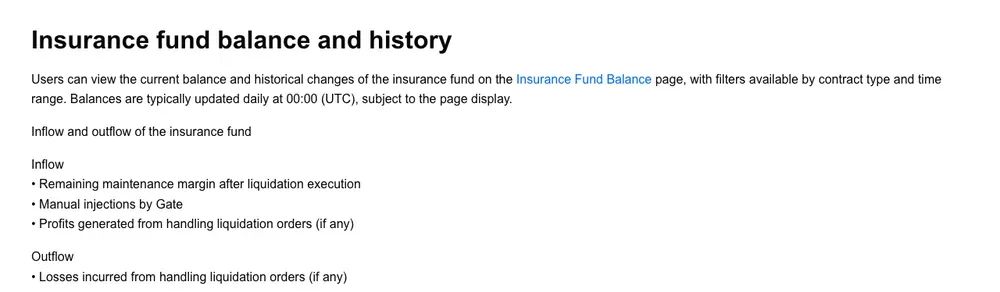
Gate's insurance fund page splits the money into inflows and outflows. There are three inflows: the maintenance margin left over after a liquidation is executed, manual injections into the fund by Gate, and any profit made from handling liquidation orders. There is one outflow: losses from handling liquidation orders.
The same page's example: bankruptcy price 100,000 USDT, 10 contracts to close, contract multiplier 0.0001. The best bid at 101,000 has 2 contracts, the second bid at 100,000 has 5, the third bid is at 99,000. The first 7 contracts fill; the remaining 3 can't be sold because the best bid is below the bankruptcy price, so the insurance fund takes them at 100,000. Average fill price = (2 × 101,000 + 8 × 100,000) ÷ 10 = 100,200 USDT; surplus = (100,200 − 100,000) × 0.0001 × 10 = 0.2 USDT, which goes to the insurance fund. On your side, all 10 contracts are settled at 100,000.
The page also says the insurance fund is not used to make up individual traders' losses. All it takes on is the part of a liquidation order the market can't absorb.
Do you have to pay back a negative balance after liquidation?
All three exchanges hand the gap left by a negative balance to the insurance fund, but some word it more firmly than others.
Binance has an Automated Negative Balance Clearance mechanism: if a bankrupt position leaves your account with a negative balance, the futures insurance fund tops it up as far as it can. The system runs every ten minutes and only handles accounts that meet all of the following:
- Multi-Assets Mode is not turned on;
- the account with the negative balance (USDⓈ-M or COIN-M) has no positions left at all, cross or isolated;
- after the liquidation, you haven't transferred funds into the account to cover the loss.
If your account doesn't qualify, the page tells you to contact customer support. When even the insurance fund can't cover the gap, the matching engine auto-deleverages the bankrupt position together with some non-bankrupt positions on the other side. That process is ADL.
OKX's liquidation FAQ, where it explains the Deleveraging Fee, says that if a position goes bankrupt and your account balance turns negative, you don't bear that loss; the insurance fund covers it. Further down the same answer, on “position reduction-related costs”, the wording shifts to the shortfall possibly being compensated by the insurance fund under the liquidation mechanism.
Gate settles everything on your side at the bankruptcy price, and its insurance fund page says your maximum loss is locked at the bankruptcy price. The risk notice on the same page, though, says the insurance fund is not a guarantee of any kind and doesn't promise that users won't lose money, and ADL can still be triggered in extreme markets.
Even when the balance is topped back up to zero, that position's margin is already gone in full. What gets covered is only the part of the loss beyond your margin.
Where the clearance fee and the estimated liquidation price show up in your account
On Binance, look through your futures transaction history for entries labelled “Liquidation Clearance”; that is the clearance fee. The liquidation price shown in your Liquidation History may not match the one calculated beforehand. The page's example: a BTCUSDT short whose liquidation price works out at 17,006 with the mark price at 17,000. The mark price jumps to 17,100 within one second, the position is liquidated at 17,100, and 17,100 is also what the record shows.
On OKX, each position on the Positions & Assets page shows an estimated liquidation price (Liq. price) in its bottom-right corner. It is only an estimate; the actual liquidation or reduction price is the mark price at the moment the maintenance margin ratio reaches ≤ 100%. To work it out yourself, tap the ··· menu on the trading page, then Features → Calculator → Liquidation Price, and enter your leverage, entry price and margin mode.
To get a rough idea of where your liquidation price will land before you open a position, this site's liquidation price calculator works it out for all three exchanges at once. It uses a simplified formula that leaves out trading fees and funding, so the real liquidation price arrives earlier than the one it shows; estimate the clearance fee separately with the rates above.